Rank Tracking & Cannibalization
Kenzsys tracks where your firm's pages rank in Google for the keywords that matter to each practice area, and checks those positions on an ongoing basis so you can see whether you're moving up, sliding down, or holding steady. Built on top of that same ranking data is a newer check: automatic detection of keyword cannibalization, where two of your own pages end up competing for the same search term instead of one page winning it outright.
What rank tracking shows
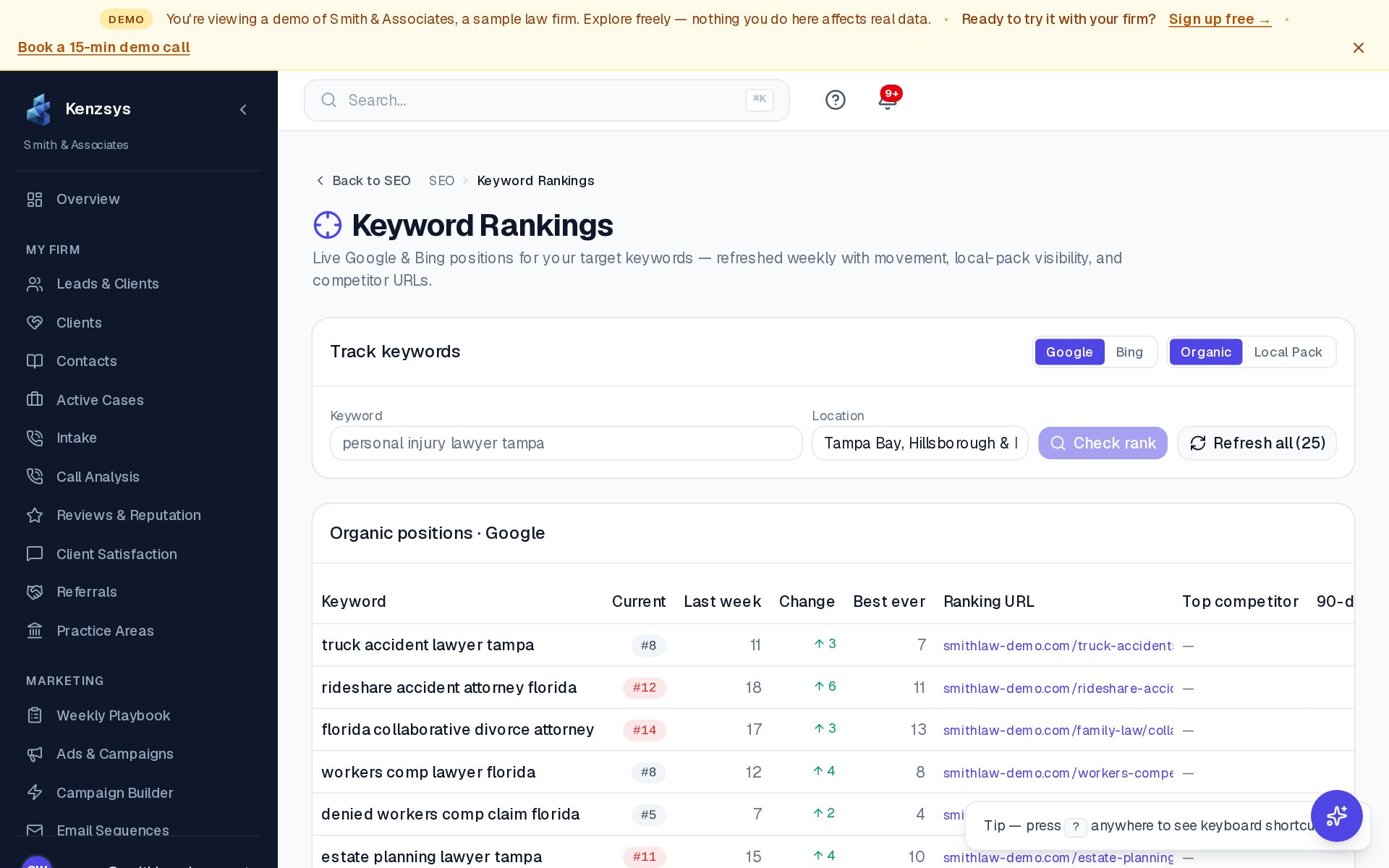
For every keyword you're tracking, Kenzsys records your current position, your previous position, and your best-ever position, organized by practice area so you can see at a glance whether "car accident lawyer Tampa" is trending differently than "workers comp attorney Tampa." Positions are checked on a regular cadence, and each entry shows which of your pages is currently ranking and whether a competitor holds a local-pack spot above you.
Use this view the way you'd use any performance dashboard: watch for keywords sliding out of the top 10 (you're losing visibility on a term that used to send traffic), and watch for keywords climbing toward page one (a chance to double down with more content or an internal link push).
Keyword cannibalization
Cannibalization is what happens when two of your own pages compete for the same keyword instead of one page clearly winning it. That's a real problem — the links and relevance that should have gone to one strong page get split across two mediocre ones, and neither ranks as well as a single consolidated page would.
But it's important to say what cannibalization is not: simply having two of your pages show up for one keyword isn't automatically a problem. Google sometimes gives a strong, trusted site a second listing directly beneath its own top result — that's a site winning a query twice, not splitting it. So Kenzsys doesn't flag every overlap. It looks for two independent signals, and every finding tells you which one fired.
- Search results page (SERP) co-occurrence. More than one of your firm's own pages appears in the live top 10 search results for a keyword right now. This is a snapshot of the current moment.
- History flapping. Looking back across your stored ranking history, the specific page that ranks for this keyword has switched more than once. A single change — for example, after a site migration or a URL redirect — doesn't count as flapping; that's just a deliberate move. It takes two or more switches, Google repeatedly changing its mind about which of your pages should answer the query, before Kenzsys treats it as a real warning sign.
A finding can have one signal or both. Each one comes with a plain-English rationale explaining exactly what was found, for example: "2 of your pages rank on page one for this term (best at #4), and the ranking page has changed 3 times across 3 URLs."
Severity levels
- High. Either both signals fired together (Google is currently showing two of your pages and has been swapping which one ranks), or the ranking page has flapped three or more times. This is the strongest evidence that you're actively losing ground on the query.
- Medium. Either co-occurrence fired on its own and neither of your pages holds a strong position, or flapping fired on its own without co-occurrence. Worth addressing, but not the most urgent items on the list.
- Low. Co-occurrence only, and your best page already holds a top-3 spot. In this case you're not losing the query — Google is likely just giving your strong site extra real estate — but it's still worth cleaning up so the weaker page isn't diluting the stronger one's authority.
What to do about it
The recommendation is almost always the same: pick the stronger of the competing pages, consolidate the content onto it, and set up a 301 redirect from the weaker page(s) to it. That tells Google (and any AI engine reading your site) which page is the authoritative answer, and it lets the links and relevance currently split across two pages start reinforcing one.
No new setup required. Cannibalization detection runs automatically against the live search results and the ranking history Kenzsys is already collecting for rank tracking — there's nothing to connect or configure.
Don't chase every low-severity finding first. A low-severity finding means you're already winning the query. Work down the list by severity so you fix the pages that are actually bleeding traffic before you tidy up the ones that aren't.