GEO Visibility (AI Search Presence)
GEO stands for Generative Engine Optimization — the practice of making sure your firm gets mentioned and cited when consumers ask AI assistants like ChatGPT, Gemini, Claude, and Perplexity about legal help. As more people start their lawyer search with a chat instead of a search box, GEO is becoming as important as classic SEO.
What does GEO mean for a law firm?
Imagine someone in your city types into ChatGPT: "best personal injury lawyer in Tampa" or "how do I sue my employer for retaliation in Florida." The AI returns a confident, paragraph-style answer that mentions specific firms by name and sometimes cites their websites. If your firm is named, you got a free, high-intent referral. If your firm isn't named — but your competitors are — you're losing business you don't even know about.
GEO Visibility tracks how often your firm shows up in those AI answers compared to your competitors.
Where to see it
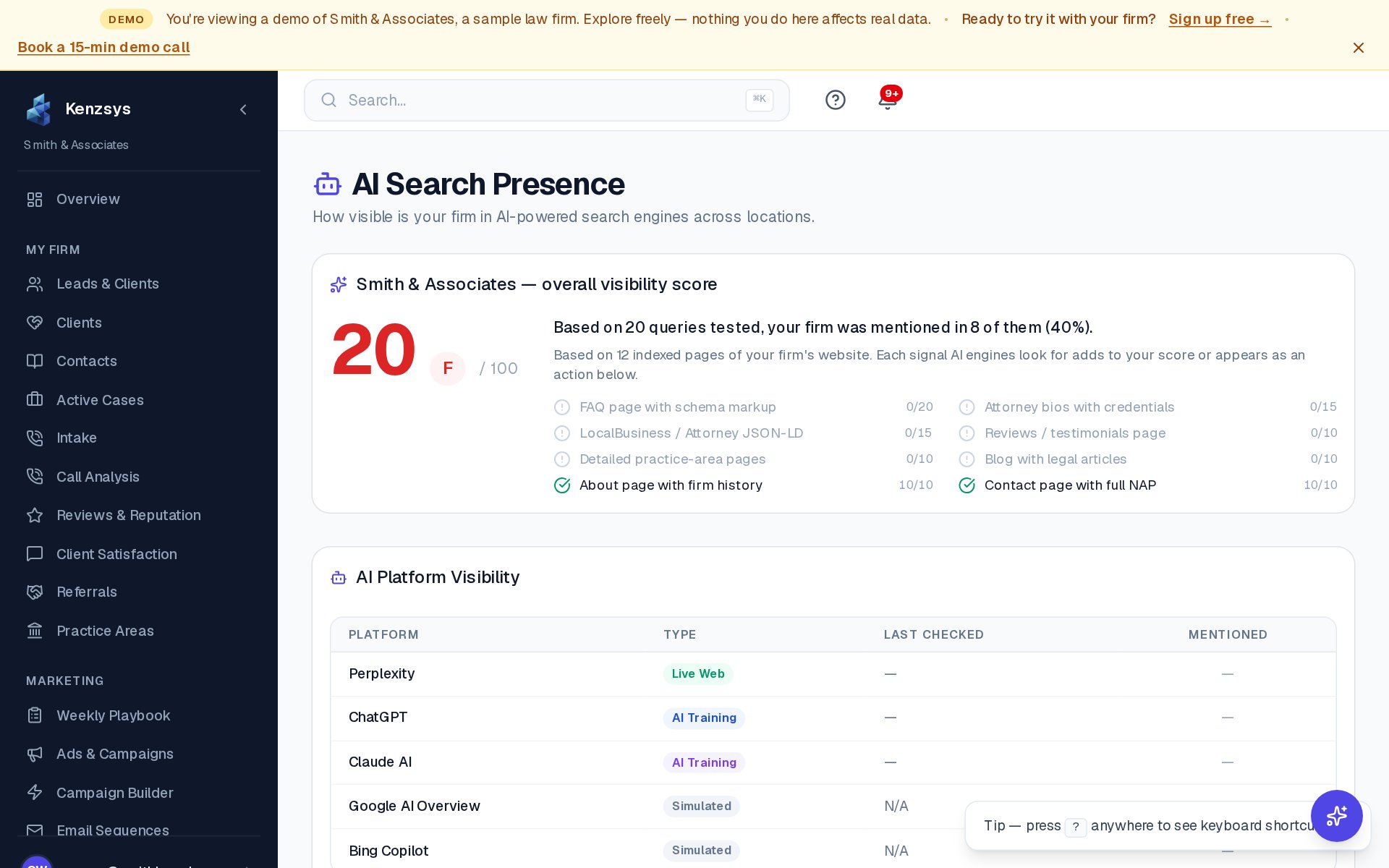
Click GEO in the left sidebar. The page shows:
- Your firm's overall GEO Score (0 to 100).
- Score breakdown by AI engine (ChatGPT, Gemini, Claude, and Perplexity).
- A list of the prompts Kenzsys tested this week and whether your firm was mentioned in each one.
- A competitor leaderboard showing other firms that appeared in your prompt set.
- Week-over-week trend chart so you can see whether your visibility is improving.
What the GEO Score means
The score is a 0-100 measure of how often your firm appears versus competitors in your market, weighted by the importance of the queries:
- 80-100 — dominant. Your firm is mentioned in most relevant AI answers in your market.
- 50-79 — competitive. You appear frequently but not consistently.
- 20-49 — present. You show up sometimes, often with competitors named alongside.
- 0-19 — invisible. You're rarely or never mentioned for the queries that matter.
How prompts are tested
Once a week, Kenzsys runs a curated set of 40 to 60 prompts through ChatGPT, Gemini, Claude, and Perplexity — the same four platforms behind the score breakdown above. The prompts are auto-generated based on:
- The practice areas you set in Settings.
- Your firm's primary office city and state.
- Common high-intent legal questions for those practice areas.
Examples: "best DUI lawyer in Phoenix," "what to do after a car accident in Tampa," "how much does a divorce cost in California." Every prompt asks the question the way a real prospective client would — your firm's name is never mentioned in the prompt. Naming the firm would only tell you whether the AI agrees your firm is good, not whether it would recommend your firm unprompted, which is the thing that actually drives referrals.
Each question is sent through DataForSEO's LLM Responses API, which grounds the platform's answer in pages fetched from the live web at the moment of the check, rather than relying on whatever the model happened to memorize during training. That's what makes it possible to check all four platforms — including Gemini, which previously had no coverage at all — the same, consistent way. Kenzsys then parses each answer for:
- Whether your firm was mentioned, and how confidently.
- The specific source URL the answer cited as your firm's own page, if any.
- Every competitor firm named in the answer.
- Your firm's rank position among the firms named, when your firm appears.
- The total number of firms named in the answer.
Every check also records whether the platform actually used live web search to produce that particular answer. Occasionally a platform answers from what it already knows instead of searching. When that happens and your firm doesn't appear, it's a weaker, inconclusive signal — not proof your firm is invisible — so don't over-read a single ungrounded miss. The score and trend are built from the full weekly panel, not any one prompt.
How to improve your score
GEO is a slower discipline than paid ads, but a handful of moves reliably improve scores:
- Get your NAP consistent. Your firm's Name, Address, and Phone must be identical across your website, GBP, Yelp, Avvo, and Justia. AI engines treat inconsistency as a credibility signal.
- Add FAQ schema to your website. AI engines lift answers directly from
schema-tagged FAQs more often than from regular content. Have your developer add
FAQPageJSON-LD to your practice area pages. - Publish authoritative long-form content. AI engines cite definitive explainer articles. One 2,000-word piece on "everything you need to know about [practice area] in [your state]" outperforms ten short blog posts.
- Get cited by reputable third parties. When local newspapers, bar associations, or industry publications link to you, AI engines weight your authority higher.
- Use the Content Studio. Kenzsys surfaces specific content gaps — prompts where competitors are mentioned but you aren't. Generating articles for those exact gaps is the highest-leverage move.
Data updates weekly. Because running the full prompt panel through every engine takes hours and is rate-limited by the AI providers, Kenzsys refreshes GEO data every Monday night. New content you publish today will show up in next week's scoring run, not today's.