
Revenue Attribution
Revenue Attribution is what lets a firm answer the question every managing partner eventually asks: which marketing dollars actually turned into paying clients? Kenzsys traces a client relationship from the very first marketing touch — the specific ad, keyword, or channel that started it — all the way through to a signed retainer and the actual matter value recorded in your case management system. Not a form submission. Not a phone call. Revenue.
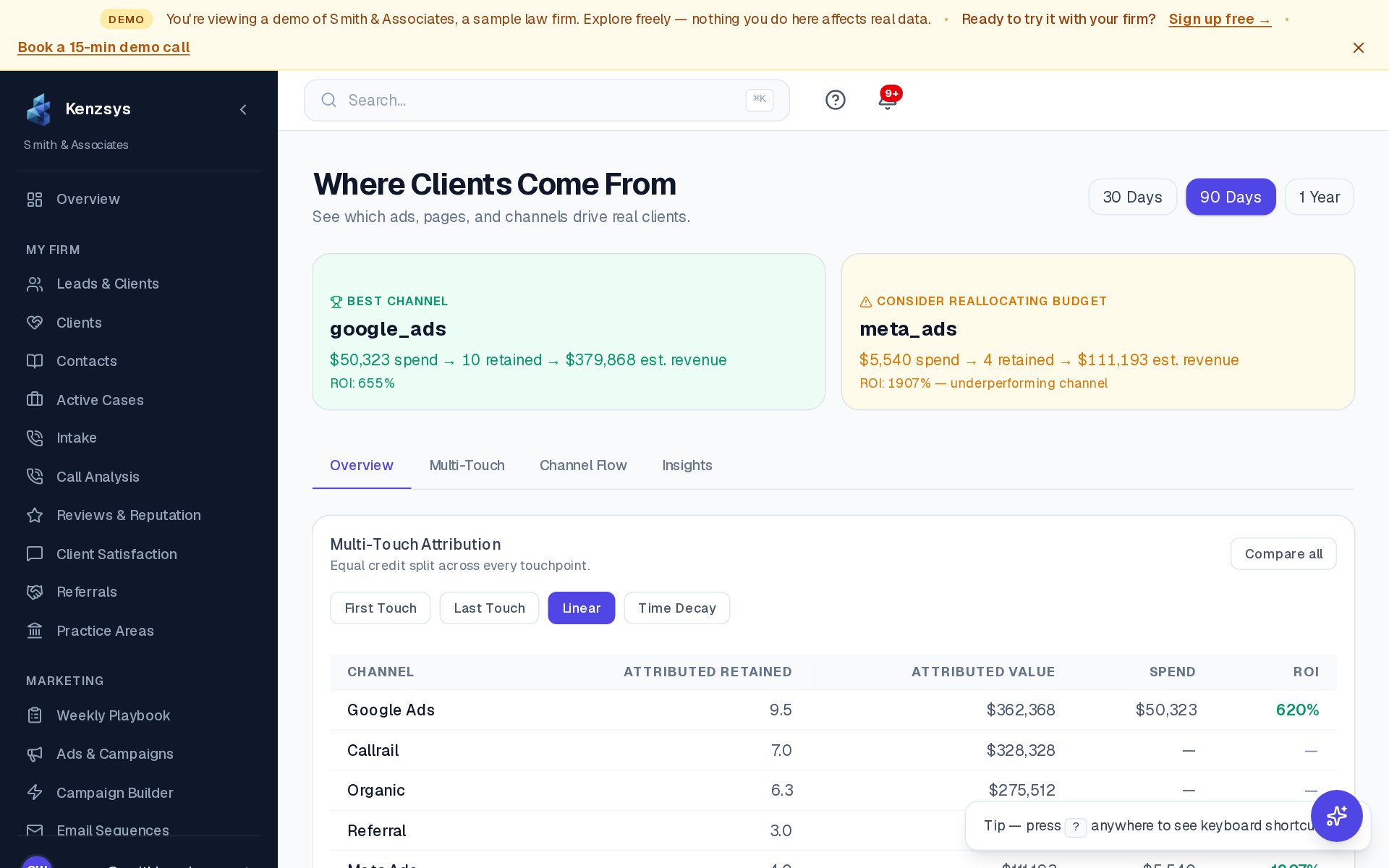
What full-funnel attribution means for a law firm
Most marketing dashboards stop at the lead. They can tell you a form was submitted or a call came in, and they can tell you what that lead cost you. What they can't tell you is whether that lead ever became a client, and if so, what the matter was actually worth. That gap is where a lot of ad budget quietly gets wasted on channels that look cheap and produce nothing.
Kenzsys closes that gap. It follows a contact from the first marketing touch — say, a Google Ads click on a specific keyword — through intake, through consultation, through signed retainer, and into the matter value your firm records in Clio or Lawmatics. The result is a complete, dollar-denominated line from ad spend to revenue, broken down by channel, by campaign, and by practice area. You can see, for example, that your "car accident lawyer near me" campaign produced twelve leads last month, but only three retained, and those three are worth a combined $85,000 in matter value — while a cheaper campaign that produced twenty leads retained none of them.
Where to see it
Revenue Attribution surfaces in two places:
- The Overview dashboard's command strip and attribution ledger — a running, date-range-filterable summary that gives you the headline numbers (spend, retained clients, revenue, revenue per channel) without leaving the home screen.
- The Attribution page — the full breakdown by channel, campaign, and practice area, where you can drill into any individual campaign to see exactly which leads it produced and what happened to each one.
Both views respect the date range picker, so you can look at trailing 30 days for a routine check-in or widen the window to a full quarter or year when you're deciding where to move budget.
Fast, reliable refresh: Attribution numbers are built to stay responsive even for firms with years of lead history. Recent improvements to how these reports are calculated mean your 30- and 60-day windows refresh promptly and consistently, and a large attribution report won't slow down the rest of your dashboard while it loads.
Cost per lead vs. cost per retained client
Cost per lead is the metric most legal marketing tools stop at, and on its own it's a weak one. A channel with a low cost per lead can still be a bad investment if none of those leads ever sign a retainer. The number that actually tells you whether a campaign is working is cost per retained client, alongside revenue per channel — what you spent to acquire each client who actually became a client, and what that channel returned in matter value.
Kenzsys is built around that distinction. Every attribution view lets you toggle between lead volume, cost per lead, cost per retained client, and revenue per channel, so you can see past the vanity metric and get to the number that should actually drive your next budget decision.
Attribution and your integrations
Full-funnel attribution depends on Kenzsys having both halves of the equation connected:
- Spend and lead source data from your ad platforms — Google Ads, Meta, and any other connected channel — so Kenzsys knows what you spent and where each lead came from. See the Google Ads integration guide for how this connection works.
- Matter revenue data from your case management system — Clio or Lawmatics — so Kenzsys knows which leads became retained clients and what those matters were actually worth.
If either side is missing, attribution will still show you what it can (spend and lead volume without revenue, or revenue without a clean source trail), but the full lead-to-revenue picture only comes together once both integrations are connected.
Controlling who sees revenue figures
Marketing spend and revenue-dollar visibility can be controlled independently of each other through Kenzsys's access-profile system. That's what makes it possible to give an outside marketing vendor or agency visibility into campaign performance and lead volume without necessarily exposing your firm's exact revenue figures. See the access-control documentation for how to set this up for a specific user or role.