Competitor Ads & Positioning
You already know who your competitors are in the courtroom. Competitor Ad Intelligence tells you who they are in the ad auction — which firms are bidding on the same keywords and practice areas as you, what their ads and landing pages are actually saying, and where their approach leaves an opening for you to take.
What Kenzsys tracks about your competitors
Kenzsys continuously scans for other firms advertising against the same keywords and practice areas your firm competes in. For each one it finds, it looks at the actual ads and landing pages they're running and works out:
- Likely positioning and messaging strategy — how they're presenting themselves (aggressive settlement promises, "no fee unless we win," local trust and reputation, speed of response, and so on).
- Apparent weaknesses — gaps in their messaging, offers they aren't making, practice areas they're spread thin across, or claims that ring hollow next to what they actually deliver.
- Specific counter-strategies — a concrete angle, offer, or message your ads aren't currently using that a competitor's gap suggests you should try.
The point isn't a one-time snapshot of the competitive landscape. It's continuous, dated findings — the kind of ongoing monitoring a firm would otherwise need to pay an agency to do by hand, watching competitor ads and pages week after week. Kenzsys does that watching automatically and surfaces what changed.
Where to see it
Competitive intelligence appears in a few connected places:
- Competitor Ads — the ad-level view: which firms are running ads against your keywords, what those ads say, and how their messaging compares to yours.
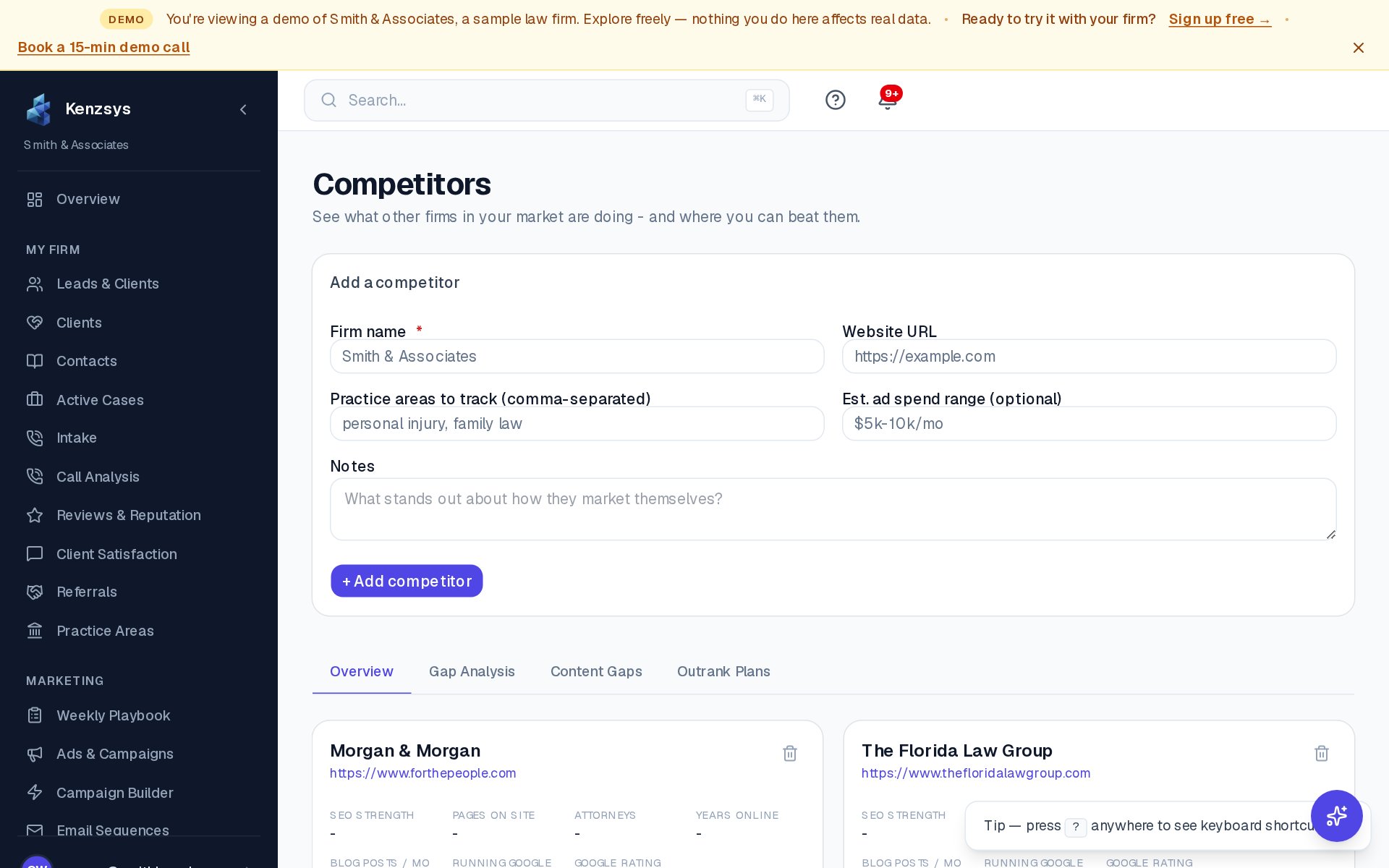
- Competitors — a firm-level view of who you're up against across channels, not just paid search.
- Competitive — the rollup of findings and recommended counter-strategies, where individual insights get surfaced as dated, actionable items rather than buried in a report.
This also connects to your legal-directory and SEO standing. Rather than just showing you an abstract ranking number, Kenzsys can show you how you compare specifically to the firms you're actually losing intake to, which is a much more useful comparison than a generic industry benchmark.
How to use a competitor finding
Each finding is meant to be actionable, not just informational. A typical workflow looks like this:
- A new finding appears flagging that a competing firm has started running ads emphasizing, say, 24/7 live intake — something your ads don't currently mention.
- Kenzsys pairs that finding with a specific recommendation: add a "we answer 24/7" line to your ad copy or landing page, or launch a campaign variant that leads with response speed.
- You review the finding and either act on the recommendation directly in your campaigns or hand it to whoever manages your ad copy.
- Because the monitoring is continuous, you'll see whether that competitor's approach shifts again, rather than finding out months later that your positioning has quietly gone stale.
Confidence, not guesswork: Findings describe what Kenzsys observes in a competitor's actual ads and pages and the strategy that pattern implies — not a claim about what's happening inside their firm. Treat each finding as a well-informed read worth weighing alongside your own judgment of the local market.